

For Those Who Served
You Don't Walk Alone
From one combat veteran to another — I was in the battle with you. I'm still here to fight with you.
This consultation is Dion's way of giving back to the brothers and sisters who served alongside him. It is completely free. Dion is a certified life coach and peer consultant — not an accredited Veterans Service Officer (VSO), attorney, or VA-recognized claims agent. His goal is to offer hope, a compassionate ear, and a clear path to the benefits you fought for and earned. For accredited legal or claims representation, please reach out to a VA-accredited VSO or attorney.
To My Fellow Veterans,
I know what it feels like to come home and leave a part of yourself behind. I served in Desert Storm, and when the battle was won overseas, I returned to a war I didn't expect — one fought inside my own mind, body, and spirit. For years I struggled to show up for my family. Keeping a job became daunting. Controlling my emotions and mental clarity felt like a task too large for any one person to carry.
I turned to the Veterans Administration for the help I needed to live, survive, and belong. After a year of tests, doctor appointments, and lab work, I was finally able to obtain the disability benefits I had earned — not something given to me, but something I fought for and deserved. The road was not easy. But I did what soldiers do: I fought until the battle was won.
Now I use everything I learned — every form, every appeal, every setback and breakthrough — to walk alongside veterans who are navigating that same road. You should not have to figure it out alone. You earned your benefits. You deserve stability. And you deserve someone in your corner who has been exactly where you are.
We leave no one behind — and that includes you.
— Dr. Dion D. Banks, Combat Veteran & Life Coach
Dual Hon. D. (Social Justice & Public Welfare, h.c.)
Support Built for Veterans
How I Can Help You
Drawing on my own VA journey and professional coaching credentials, I offer veterans practical guidance and compassionate support across three areas.
VA Benefits Peer Consultation
As a fellow veteran who navigated the VA process myself, I share what I learned — how the system works, what questions to ask, and where to find accredited help. I am not a VSO or attorney; I am a peer who has been through it and can help you see the path forward.
Trauma-Informed Coaching
Combat changes you. Reintegration is its own battle. Through trauma-informed coaching I help you process what you carry, rebuild your sense of identity, and move forward with purpose — at your pace.
Stability & Life Skills
Employment, family relationships, emotional regulation, and daily structure — I work with you to rebuild the foundations that service and trauma can shake. Stability is not a luxury; it is your right.
Why Trust This Journey to Me
Qualified to Walk This Road With You
Veterans Advocacy Update
A Major Win for Veterans 🇺🇸
Secondary service connection just got stronger.
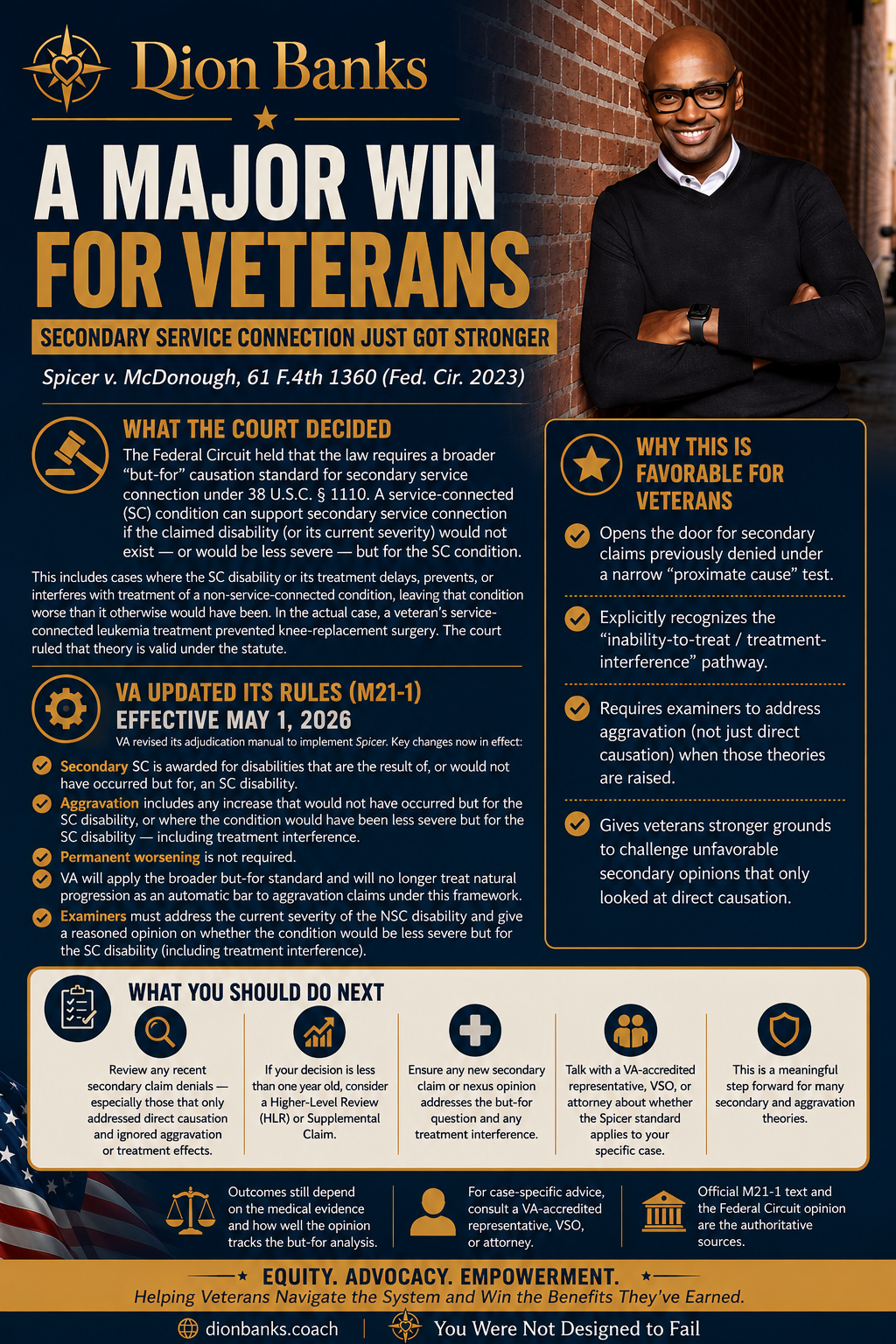
The Ruling: Spicer v. McDonough, 61 F.4th 1360 (Fed. Cir. 2023)
The Federal Circuit held that the law requires a broader "but-for" causation standard under 38 U.S.C. § 1110. A service-connected condition can support secondary service connection if the claimed disability — or its current severity — would not exist but for the service-connected condition.
This includes cases where the service-connected disability or its treatment delays, prevents, or interferes with treatment of a non-service-connected condition.
VA Updated M21-1 — Effective May 1, 2026
- 1Secondary SC is awarded for disabilities that are the result of, or would not have occurred but for, a service-connected disability.
- 2Aggravation includes any increase that would not have occurred but for the SC disability — including treatment interference.
- 3Permanent worsening is not required.
- 4Examiners must address current severity and give a reasoned opinion on whether it would be less severe but for the SC disability.
What You Should Do
If you have a recent secondary claim denial that only addressed direct causation and ignored aggravation or treatment effects, review it. If the decision is less than one year old, consider a Higher-Level Review or Supplemental Claim. Make sure any new secondary claim or nexus opinion addresses the but-for question and any treatment interference.
I'm launching a new venture this fall that includes a focused component for veterans — helping them better understand VA law and disability claims so they can navigate the system with more clarity and confidence.
Visit the Veterans Support PageEquity. Advocacy. Empowerment. — Helping veterans navigate the system and win the benefits they've earned.
The Facts on the 55+ Rule: What VA Can — and Cannot — Do After You Turn 55
Federal regulation and VA's own internal manual set clear limits on routine reexaminations for veterans 55 and older. Here is exactly what the law says — and what it doesn't.
Source 1 · Federal Regulation
38 CFR § 3.327(b)(2)(iv)
"No periodic reexamination will be scheduled … in cases of veterans over 55 years of age, except under unusual circumstances."
The same "over 55 … only under unusual circumstances" language appears in both the compensation section § 3.327(b) and the pension section § 3.327(c) of the same regulation.
Read 38 CFR § 3.327 on eCFR.govSource 2 · VA Internal Manual
M21-1, Part IV, Subpart ii, Ch. 1, § A
"With only rare exceptions, Veterans over the age of 55 must not be routinely recalled for reexamination."
The manual instructs rating specialists to consider the veteran's age at the time the exam would actually be conducted — not just the date of the rating decision. If the veteran will have reached 55 by then, the exam should not be scheduled absent unusual circumstances or a specific regulatory requirement.
Updated as recently as May 2025 on the VA Knowledge Base.
What This Means in Plain Language
Once you are 55 (or will be 55 by the time an exam would occur), VA generally stops scheduling routine future reexaminations.
Turning 55 does not make your rating permanently "untouchable." Other events — new claims, surgery, certain medical changes — can still trigger a review.
Exceptions exist only if a specific regulation requires an exam (e.g., certain post-cancer or post-surgery situations) or if the rating activity finds "unusual circumstances."
This is separate from the 5-year, 10-year, and 20-year rating protections under 38 CFR § 3.344 and § 3.951 — those are different rules.
Important: "Unusual circumstances" is not exhaustively defined by VA — it is left to the discretion of the rating activity on a case-by-case basis. This information is educational only and is not legal advice. Veterans should consult an accredited VSO representative or attorney for guidance on their specific situation.
"You did not serve this country so your benefits could sit in a file cabinet. You earned every dollar, every rating, every resource — and my job is to make sure you know how to claim what is already yours."
Dion D. Banks · Combat Veteran & Life Coach
Dion Banks has spent decades helping veterans navigate the VA system, understand their rights, and access the compensation, healthcare, and support they have earned through their service.
Understanding VA Math
The VA does not simply add your ratings together. It uses the "whole-person" efficiency concept under 38 CFR § 4.25 — meaning each new rating is applied only to the remaining healthy percentage of you, not the original 100%. Here is exactly how it works.
How VA Math Works
Start with your highest rating and work downward.
Subtract that percentage from 100% to find your remaining efficiency.
Apply the next rating to the remaining efficiency only — not the full 100%.
Repeat for each additional condition.
Round the final combined value to the nearest 10% (0.5+ rounds up; below 0.5 rounds down).
Bilateral factor (38 CFR § 4.26): disabilities affecting both arms, legs, or paired organs get an extra 10% of their combined value added before folding into the overall rating.
Worked Example
50% PTSD + 20% Back + 10% Tinnitus — why the result is 60%, not 80%
100% − 50% = 50% remaining
20% of 50% = 10% → 50% + 10% = 60%
10% of 40% = 4% → 60% + 4% = 64%
64% rounds DOWN to 60%
Key takeaway: Multiple conditions make later ratings have progressively smaller impact. That is why reaching the next 10% threshold — especially 90% → 100% — often requires strategic secondary claims or TDIU consideration.
The numbers on that rate table are not charity. They are the price this country agreed to pay for what you gave — your body, your mind, your years. Know what you are owed. File for every dollar of it.
— Dr. Dion D. Banks
Dual Hon. D. (Social Justice & Public Welfare, h.c.) · Combat Veteran · Desert Storm
2026 VA Disability Compensation Rates
Effective December 1, 2025 (2.8% COLA). Payments are tax-free. Dependent additions begin at 30%+.
10%
$180.42
flat rate / no dependents
20%
$356.66
flat rate / no dependents
| Rating | Veteran Alone | With Spouse | Spouse + 1 Child |
|---|---|---|---|
| 30% | $552.47 | $617.47 | $666.47 |
| 40% | $795.84 | $882.84 | $947.84 |
| 50% | $1,132.90 | $1,241.90 | $1,322.90 |
| 60% | $1,435.02 | $1,566.02 | $1,663.02 |
| 70% | $1,808.45 | $1,961.45 | $2,074.45 |
| 80% | $2,102.15 | $2,277.15 | $2,406.15 |
| 90% | $2,362.30 | $2,559.30 | $2,704.30 |
| 100% / TDIU | $3,938.58 | $4,158.17 | $4,318.99 |
Additional children, school-age dependents, Aid & Attendance, and dependent parents add further amounts. Full tables at va.gov/disability/compensation-rates (effective December 1, 2025).
VA math is not designed to confuse you — but it can. Once you understand the formula, you stop accepting a number and start building a strategy. Knowledge of how your rating is calculated is the first step toward making sure it actually reflects your sacrifice.
— Dr. Dion D. Banks
Combat Veteran & Life Coach · Desert Storm
2027 COLA: 3.6% Increase Expected for VA Benefits
The Social Security Administration announced a 3.6% cost-of-living adjustment for 2027 on October 14, 2026. VA disability compensation, DIC, and related benefits are expected to increase by the same percentage once Congress passes the annual Veterans' Compensation Cost-of-Living Adjustment Act — which it has done in prior years.
Effective date
Dec. 1, 2026
First higher payment ~Dec. 31, 2026
Action required
None
The adjustment is automatic
100% rate (projected)
~$4,080.37
Veteran alone — up from $3,938.58
Official VA rate tables for 2027 will be published after the legislation passes. Always verify current figures at va.gov. Educational information only — not legal advice.
Key Dependent Add-Ons (Approximate)
$32–$109
Each child under 18
scales with rating
$105–$352
School-age child (18–23)
qualifying program
$61–$201
Spouse Aid & Attendance
additional amount
Varies
Dependent parent(s)
additional amounts apply
TDIU — Total Disability Based on Individual Unemployability
TDIU pays at the 100% rate ($3,938.58/mo for a veteran alone) even if your combined schedular rating is lower — provided you meet the criteria:
- One service-connected condition rated at 60%+ OR combined rating of 70%+ with at least one condition at 40%+
- Unable to maintain substantially gainful employment due to service-connected disabilities
Educational purposes only — not legal advice. Rates and rules are subject to change. Always verify current figures at va.gov and consult an accredited VSO representative or attorney for advice on your specific situation.
PACT Act & Toxic Exposure Benefits
If you served in the Gulf War, Desert Storm, Iraq, Afghanistan, or another qualifying location and have a respiratory condition, certain cancers, or another illness on VA's presumptive list — you may no longer have to prove the medical "nexus" the old way. The Sergeant First Class Heath Robinson PACT Act of 2022 added more than 20 presumptive conditions, expanded Agent Orange locations, and opened VA health care to millions of toxic-exposed veterans without requiring a disability rating first.
By the Numbers — What the PACT Act Changed
Each bar shows scale relative to the largest figure.
What "Presumptive" Actually Means
A presumptive condition means VA assumes your service caused the condition if two things are true:
You have a current diagnosis of a listed condition.
You served in a qualifying location during a qualifying time period.
You still need medical evidence of the diagnosis. You generally do not need a separate medical opinion proving burn pits or Agent Orange caused it. That is the point of the law. If your condition is not on the list, you can still file using the traditional service-connection elements — the PACT Act did not close that door.
Before vs. After the PACT Act
Here is what changed for veterans trying to get benefits for toxic exposure.
Qualifying Service Locations
VA presumes toxic exposure if you served on the ground or in the airspace above these locations. Airspace counts.
On or after August 2, 1990
Gulf War / Desert Storm
On or after September 11, 2001
Post-9/11 Operations
Presumptive Conditions
Always confirm the live list on VA.gov before you file — VA has expanded these over time.
Presumptive Cancers
Presumptive Illnesses (Non-Cancer)
How Many Conditions Are Covered?
A breakdown of the categories VA now recognizes as presumptive under the PACT Act and existing law.
* Counts reflect the conditions listed on this page. VA continues to expand the list — always verify the current full list at VA.gov.
Agent Orange — PACT Additions & Longstanding Conditions
Added by PACT Act
New Agent Orange Conditions
Longstanding List
Existing Agent Orange Conditions
How the Law Rolled Out — Key Dates
The PACT Act did not happen all at once. Here is the timeline of what opened and when.
Aug 10, 2022
PACT Act Signed Into Law
President Biden signs the Sergeant First Class Heath Robinson PACT Act — the largest expansion of VA benefits in decades.
Jan 1, 2023
Presumptive Conditions Take Effect
VA begins processing claims under the new presumptive rules for burn pit exposure, toxic cancers, and respiratory illnesses.
Oct 1, 2023
Toxic Exposure Screenings Required
VA must now offer a toxic exposure screening to every enrolled veteran — at enrollment and at least every 5 years after.
Mar 5, 2024
VA Health Care Enrollment Expanded
Millions of toxic-exposed veterans become eligible to enroll in VA health care — no disability rating required. VA opened enrollment years ahead of the statutory deadline.
Ongoing
VA Continues Adding Conditions
VA reviews and expands the presumptive list on a rolling basis. Check VA.gov regularly — a condition not covered today may be added.
Expanded VA Health Care — No Rating Required
This is one of the most overlooked parts of the law. You may enroll in VA health care now — without first winning a disability claim — if you served in any of the following:
Vietnam War, Gulf War, Iraq, Afghanistan, or any combat zone after 9/11
Deployed in support of the Global War on Terror
Exposed to burn pits, chemicals, radiation, depleted uranium, or other hazards at home or abroad
Starting March 5, 2024, VA expanded enrollment to millions of toxic-exposed veterans years earlier than the statute required.
Toxic Exposure Screening — What It Is & How to Get One
The PACT Act requires VA to offer a toxic exposure screening (TES) to every enrolled veteran — an initial screening, then at least once every 5 years.
What the Screening IS
What the Screening is NOT
Local for Eastern Shore Veterans:
Cambridge VA Clinic · 830 Chesapeake Drive, Cambridge, MD 21613
MD PACT Screening Page VET-HOME PortalIf You Were Denied Before the PACT Act — Do Not Assume It's Final
If you have a new diagnosis on the presumptive list, or the law now covers your location or condition, you have options:
Submit new and relevant evidence — often the diagnosis itself plus service records showing location/dates.
Protects your effective date while you gather records.
If a claim is already pending for a listed condition, VA should consider the new presumption — but verify it.
Quick Action Checklist
Confirm your locations and dates against the qualifying lists above.
If you are not enrolled in VA health care, apply now — no rating required.
Ask for a toxic exposure screening at your next VA appointment (or call VET-HOME).
Get current diagnoses in writing for any listed condition.
File a new claim or Supplemental Claim for listed conditions.
Submit an Intent to File if you need time to gather records.
Use an accredited VSO for the filing itself.
If you want help thinking through the process or documentation, reach out through the contact page.
Official Resources — Bookmark These
Disclaimer: This page is educational. Lists of presumptive conditions, locations, and eligibility rules change. Confirm current rules on VA.gov or with an accredited representative before you file. Coaching support is not legal representation and is not a substitute for a VSO, accredited claims agent, or attorney.
"The PACT Act did not give veterans something they didn't earn — it finally removed the burden of proving what we already know. You breathed that air. You stood on that ground. The law now says that is enough. Go claim what is yours."
Dion D. Banks · Combat Veteran & Life Coach
Claims Processing Is Moving Faster — Here Is What That Means for You
VA reported record-breaking claims output in FY 2026. Faster processing is real — but speed alone does not win claims. Evidence, nexus opinions, and the Spicer but-for standard still determine the outcome.
Disability claims processed in FY 2026 (as of Sept. 18)
Surpasses prior FY 2025 record
Average processing days in September 2026
Down from 141.5 days on Jan. 20, 2025
Claims-processing accuracy
Highest in two years
Backlog reduction since early 2025
Below 70,000 for first time since early 2020 (July 2026)
$207 Billion Awarded This Fiscal Year
VA has awarded more than $207 billion in compensation and pension benefits so far in FY 2026. That money belongs to veterans who filed, documented their conditions, and stayed in the process. Faster processing means your claim can reach a decision sooner — but only if it is in the queue.
A faster system does not lower the evidence bar. You still need a diagnosis, a nexus opinion, and — for secondary claims — the but-for argument Spicer v. McDonough now supports. File complete. File now.
Executive Order — Faster Records Sharing (Sept. 2026)
A September 2026 Executive Order directs faster sharing of military service records between DoD and VA. VA projects this could shorten processing for recently separated veterans by an additional 20–30 days once implemented. No action required from veterans — this is a back-end change.
Shorter VA Form 21-526EZ
VA is advancing a simplified disability compensation application — cut from 15 pages to 5 pages, with estimated completion time dropping from ~25 minutes to ~15 minutes. A similar reduction is planned for the DIC/survivors form (21-534EZ).
Do not wait for the shorter form. The current form remains valid and your effective date is protected from the date you file — not the date the new form arrives. File now with the current 21-526EZ.
Desert Storm Veterans — Gulf War Presumptive Clarification
The old statutory deadline requiring certain chronic undiagnosed illnesses to manifest by December 31, 2026 was removed by the PACT Act. That deadline no longer applies.
However, the implementing regulation (38 CFR § 3.317) has lagged in some VA offices. If you are a Desert Storm-era veteran and a rater cites the old deadline or a manifestation cutoff, that is an error — push back, request a Higher-Level Review, or consult an accredited VSO. The PACT Act removed the deadline; the regulation must follow.
2026 VA Federal Benefits Guide — Now Available
Released around October 1, 2026. A practical all-in-one resource covering compensation, pension, education, home loans, life insurance, and more. Bookmark it.
Note: Processing statistics are from VA press releases (FY 2026, as of September 18, 2026). Figures reflect system-wide averages — individual claim timelines vary by type, complexity, and evidence. Coaching support is not legal representation and is not a substitute for an accredited VSO, claims agent, or attorney.
Veteran Voices
Veteran Voices
"He treated my fight like it was his own."
I am a U.S. Army Veteran and an educator in Cambridge, Maryland. I came to Dion Banks worn down by VA processes I had been fighting for years, and looking for someone who would help me put my professional story in order as well.
Dion is a combat veteran. That mattered. He did not talk down to me. He listened, explained the process in plain language, and was clear from the first conversation that the benefits work we were doing would not put my existing disability rating at risk.
He redesigned my résumé to reflect who I actually am: a senior educator, Army Veteran, and community leader with more than 20 years supporting youth, families, and schools. The new résumé highlights my work as a Behavior Intervention Teacher with Dorchester County Public Schools, my case management and restorative practice background, and my record of building partnerships that serve children, families, and veterans. It reads like the professional I am — not a stack of disconnected jobs.
On the benefits side, he did real work, not slogans: a complete first-call intake, a written case and Veteran statement for my clothing-allowance application, draft answers for VA documents, language I could take to my VA doctor, and a step-by-step plan so I knew what to do next and in what order. He helped me name how service-connected conditions and required treatment have changed my daily life, and he kept the claim inside the rules so it could stand up.
If you are a veteran who is tired of asking and getting nowhere, or a professional who needs your story told with dignity, this is the support I needed: another veteran who will walk the process with you, protect what you already earned, and help you put complete, usable work in your hands.
— Patricia E. Hawkins
U.S. Army Veteran · Educator · Cambridge, MD
"Dion willingly gives of his time and knowledge to help others — and he does an outstanding job."
Dion has been a guest speaker at Sojourner-Douglass College and led a Job Readiness seminar for youth with Wicomico County NAACP. He did an outstanding job — and he volunteered his time for both events.
He willingly gives of his time and knowledge to help others. His ability to connect with young people, veterans, and community members — and to deliver practical, usable guidance — is exactly the kind of leadership our community needs.
— Mary Ashanti, President
Wicomico County NAACP Branch #7028 · Community Advocacy & Youth Leadership
"A highly-skilled change-agent whose exceptional capacity for planning and coalition-building is enabling him to push forth game-changing results."
Dion is a highly-skilled change-agent with years of progressive leadership. His exceptional capacity for planning, outreach and coalition-building are enabling him to push forth game-changing results in areas that will impact our region for decades to come.
He is the kind of advocate who does not stop at the surface — he goes deep, builds the case, and stays with the people he serves until the work is done.
— Doris Sampson Mason, MSW
Experienced Administrator · Community Leadership
A Resource — Not a Hotline
Dr. Banks is available as a peer resource, guest speaker, and presenter for veteran-focused organizations, community groups, and events. If you are looking for someone who has lived it, studied it, and can speak to it — reach out through the contact page.
No cost to veterans. Dr. Banks is a certified life coach and peer consultant — not an accredited Veterans Service Officer (VSO), attorney, or VA-recognized claims agent. He does not provide legal advice or claims representation. What he offers is peer insight, educational context, and a clear path forward so you know exactly where to go and what to do next. For accredited legal or claims representation, please reach out to a VA-accredited VSO or attorney.